
Blog
The Lighting Mistake That Makes Your Gaming Setup Look Cheap

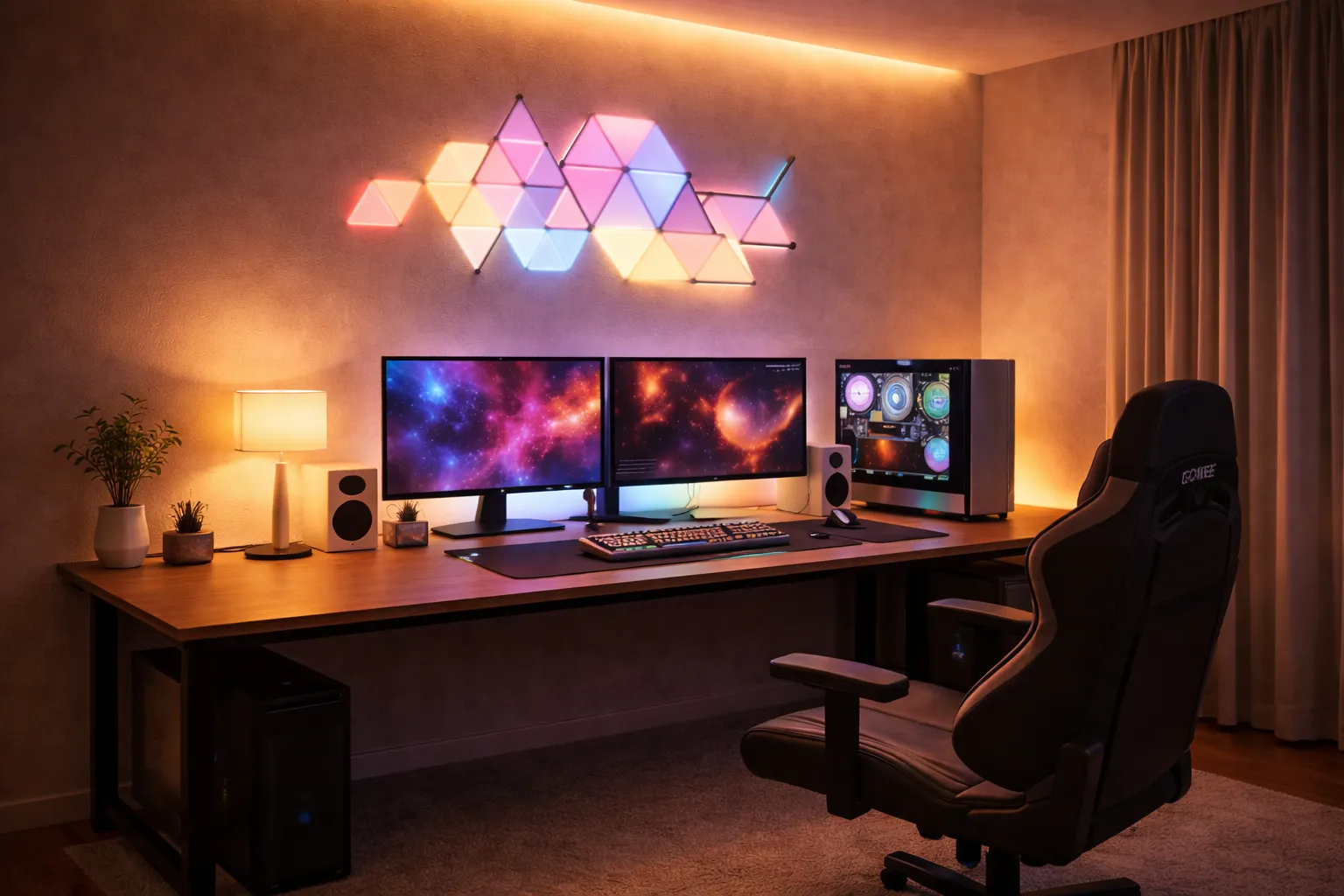
Gaming setups are no longer a niche hobby corner. They are part of a larger consumer market built around identity, entertainment, streaming, home tech, and room design. Newzoo reported that the global games market generated $188.8 billion in 2025 and counted 3.6 billion players worldwide, which helps explain why gaming-room aesthetics have become such a visible retail category.
That growth has changed how people shop for lighting. Buyers are no longer looking only for keyboards, monitors, and chairs. They want a setup that looks immersive on camera, feels impressive in person, and reflects the amount of money they have already invested in their gear. That is why this topic matters so much in retail. When someone searches “The lighting mistake that makes your gaming setup look cheap,” they are not just asking a design question. They are trying to protect the perceived value of the whole setup.
In most cases, the biggest mistake is simple: using lighting as decoration instead of structure. A setup may have RGB strips, monitor backlights, and glowing accessories, but if the lighting is harsh, exposed, poorly placed, or visually unbalanced, the whole room can still feel low-end. The issue is rarely the presence of light. It is the way light shapes the space.
Search intent behind “The Lighting Mistake That Makes Your Gaming Setup Look Cheap”
The search intent behind this keyword is informational with strong commercial investigation value. The reader is usually in one of three situations.
The first is that they already own RGB lights but feel disappointed by how their desk or room looks in real life. The second is that they are upgrading a gaming setup and want it to look more premium without wasting money on random accessories. The third is that they are comparing lighting products and want to know which ones create a cleaner, more intentional result.
This is why the keyword is so commercially useful. The user is already emotionally close to a purchase. They are not searching for “what is ambient lighting.” They are searching because something looks off. That frustration often leads directly to buying better lighting, reorganizing the space, or adding a more refined ambient layer.
The mistake: too much visible RGB, not enough controlled ambient light
The lighting mistake that makes most gaming setups look cheap is relying too heavily on exposed RGB effects while ignoring controlled ambient lighting.
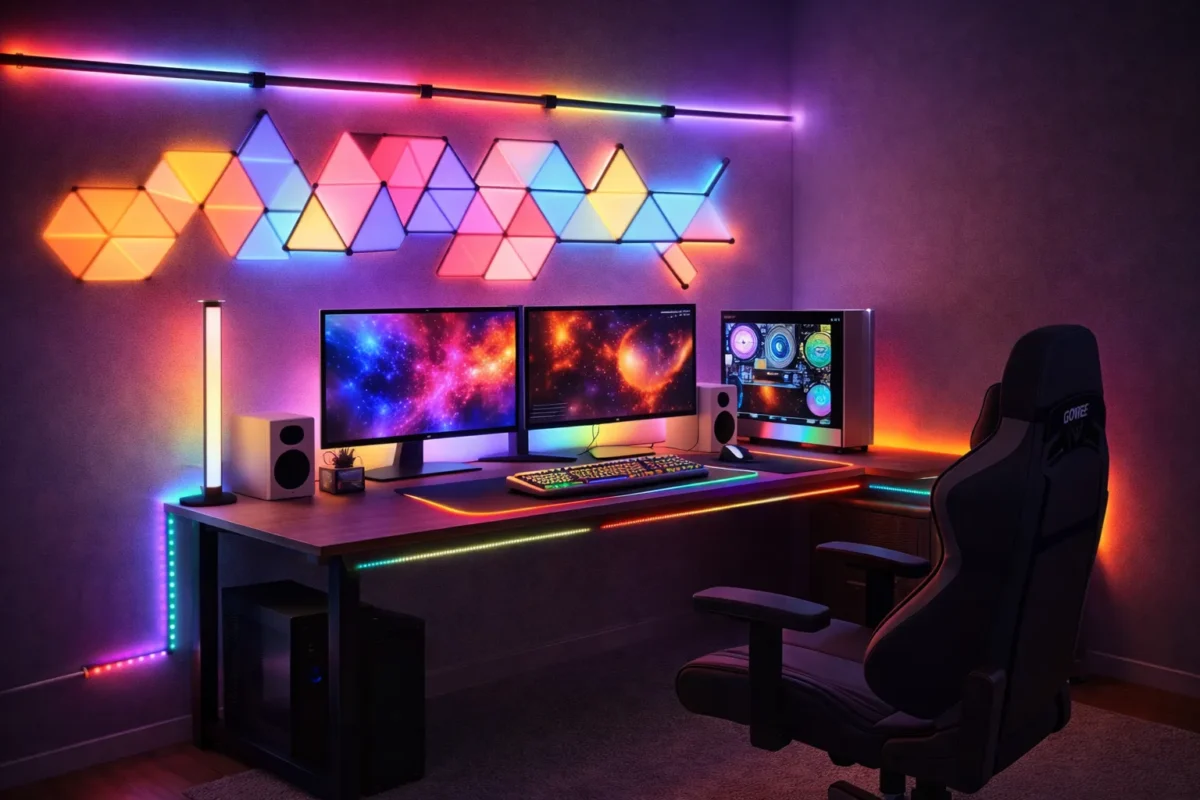
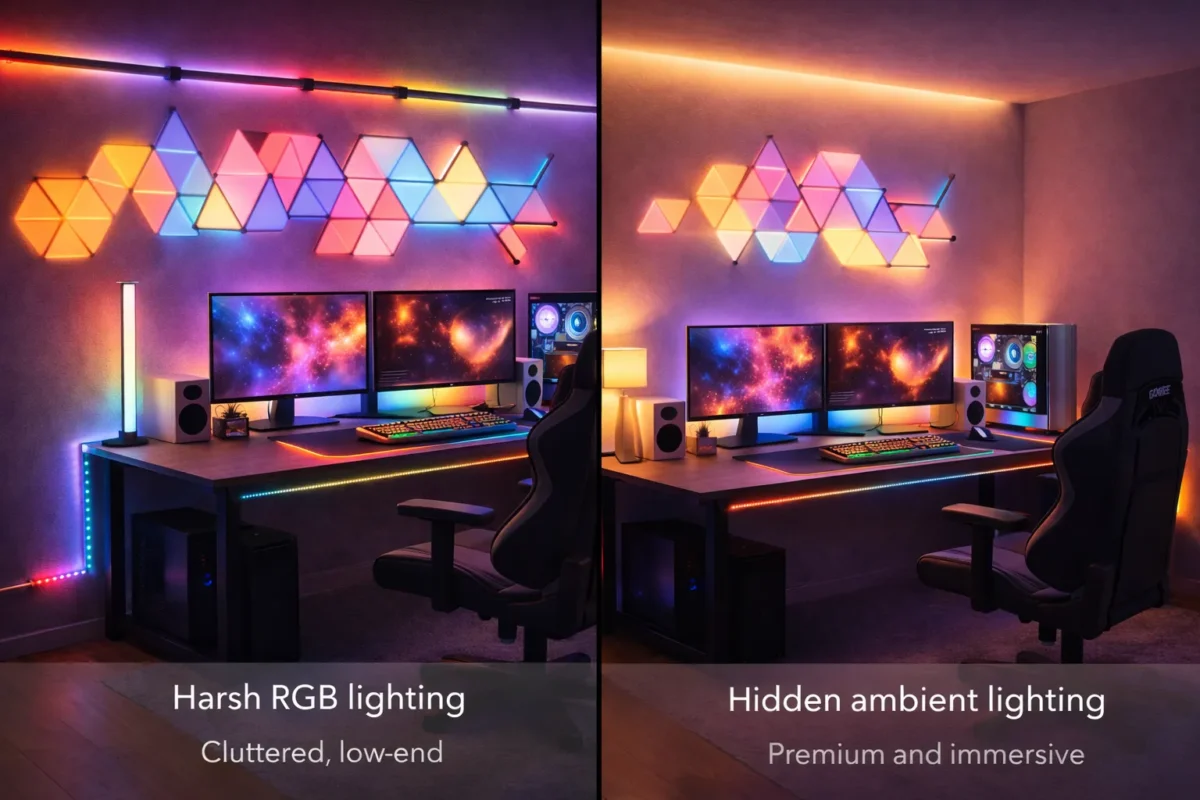
Exposed strips around every edge of the desk, bright color blasts behind the monitor, and too many separate glowing accessories often create visual noise instead of atmosphere. The setup may look busy, but not premium. It may feel bright, but not deep. It may look colorful in product shots, but cluttered in real life.
Good lighting design is not only about brightness. The U.S. Department of Energy’s residential lighting guidance highlights glare control, the effect of surface brightness on how rooms feel, and the role of ambient, task, and accent lighting as separate layers. When one gaming setup depends almost entirely on exposed RGB, it often skips exactly the design principles that make a room feel finished.
That is why two setups with similar budgets can look completely different. One feels immersive and expensive. The other feels like a collection of glowing gadgets.
Why exposed lighting looks cheaper than indirect lighting
Indirect lighting usually looks more premium because the eye sees the glow, not the source. Hidden or diffused light softens the room, adds depth to surfaces, and creates cleaner transitions between desk, wall, and background.
Visible strips, on the other hand, often reveal dots, uneven diffusion, tape lines, glare, and installation shortcuts. That can instantly lower the perceived quality of the setup, even if the products themselves were not cheap.
The Department of Energy’s lighting material explicitly discusses glare control and how surface brightness affects the perception of space, which is highly relevant for gaming rooms where monitors already create intense focal brightness. When lighting around the setup adds more direct glare instead of balanced ambient support, the room often feels harder on the eyes and visually less refined.
Why one color everywhere makes the setup look flat
Another mistake is relying on one aggressive RGB color across everything. All-blue, all-purple, or all-red rooms may feel dramatic for a few minutes, but they often reduce depth and make the setup feel less expensive over time.
A more premium room usually has contrast. There is a base layer of soft ambient light, one or two controlled accent colors, and enough neutral space to let the lighting breathe. Without that balance, the setup can look like a preset rather than a designed environment.
This is also one reason high-end setups often photograph better than average ones. The better rooms do not necessarily have more lighting. They usually have more restraint.
Why harsh lighting makes premium gear look worse
A cheap-looking setup is often not caused by cheap products. It is caused by lighting that makes good products look worse.
Harsh light flattens materials. It makes textured mousepads, matte monitor bezels, desktop surfaces, speaker housings, and wall finishes lose depth. It also exaggerates clutter. Cables, random objects, and surface dust become more visible when the room has no visual hierarchy.
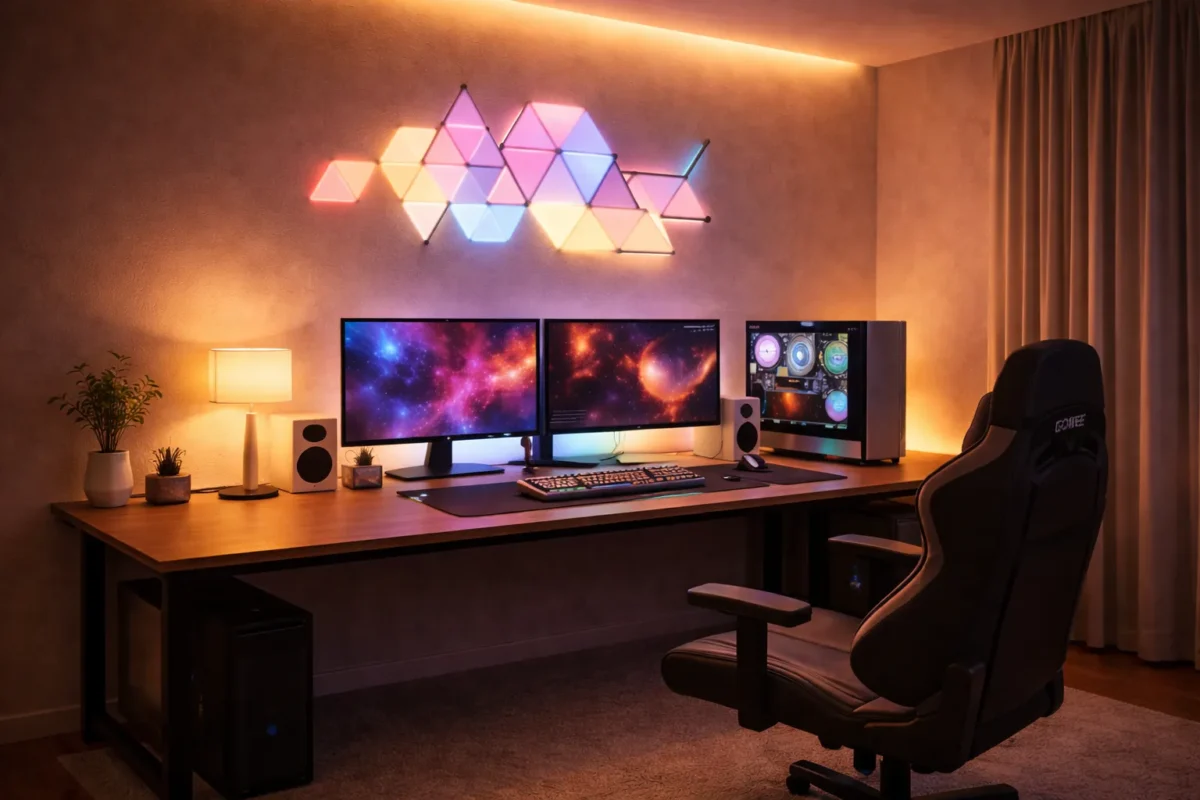
By contrast, better ambient lighting can make the exact same gear look more expensive. Soft wall glow behind the monitor, a diffused side light, or a controlled backlight behind shelves can create separation and make the setup feel intentional.
Screen-heavy setups need lighting balance, not just effects
Gaming setups are already dominated by bright screens. That changes how room lighting should work.
Harvard Health notes that blue light in the evening can suppress melatonin, and screen-heavy environments are already blue-weighted by default. In practical terms, that means gaming spaces often benefit from warm or neutral supporting ambient light rather than only adding more cold, intense light around the display area.
This does not mean gaming setups should avoid RGB. It means the supporting layer should be smarter. When the room already has bright monitors, the surrounding ambient light should reduce contrast stress, not intensify it.
That is also why bias lighting behind monitors and softer wall-directed glow tend to feel better than blasting high-saturation light straight into the room.
What a premium-looking gaming setup usually gets right
Premium-looking setups usually do five things well.
First, they hide the light source whenever possible.
Second, they separate ambient lighting from accent lighting.
Third, they leave some darkness and negative space instead of lighting every edge.
Fourth, they use color with restraint.
Fifth, they make the room look intentional from both the desk view and the doorway view.
That last point matters more than people think. Many setups are designed only for the seated perspective. But if the room looks messy or unbalanced when someone walks in, it will still feel cheaper overall.
The difference between “RGB setup” and “designed setup”
A lot of gaming spaces are built around products. Better gaming spaces are built around composition.
An RGB setup focuses on visible effects: strips, fans, bars, and panels. A designed setup focuses on how the whole room reads: wall depth, desk silhouette, furniture balance, background cleanliness, and visual hierarchy. The first approach can still be fun. The second is what usually creates a premium look.
This is where lighting becomes a retail decision, not just a decoration choice. The buyer is not only purchasing brightness or color modes. They are purchasing a more expensive-looking environment.
The fastest fix: reduce glare and add one quiet ambient layer
If a setup already looks too busy or cheap, the first fix is not to buy more RGB accessories. The first fix is usually to remove one noisy light source and add one calm one.
That could mean:
a hidden LED strip behind the desk
a soft wall wash behind the monitor
a diffused floor lamp behind the chair
a warm-neutral side light for room balance
a subtle wall-mounted light that adds form instead of glare
One controlled ambient layer often improves a gaming room more than three extra glowing gadgets.
Gaming setup lighting mistakes and better fixes
| Common mistake | Why it looks cheap | Better fix |
|---|---|---|
| Exposed LED strips everywhere | Reveals glare, dots, and clutter | Hide the source and use indirect glow |
| One RGB color across the whole room | Flattens depth and looks generic | Use layered tones with some neutral balance |
| Lighting every edge of the desk | Creates visual noise | Leave some negative space |
| Only monitor RGB, no room lighting | Setup looks isolated and unfinished | Add one soft ambient layer in the room |
| Harsh overhead light with RGB accents | Conflicting mood and poor depth | Lower ceiling brightness and support with indirect light |
| Too many small glowing devices | Feels gadget-heavy, not designed | Use fewer, stronger focal lighting choices |
What shoppers should look for when buying gaming setup lighting
Buyers who want a more premium-looking setup should focus less on “how many effects” a product offers and more on how cleanly it integrates into the room.
The best products for this purpose usually have:
diffused output
low visible glare
good wall-wash potential
dimming control
adjustable color temperature or balanced RGB scenes
easy placement behind desks, monitors, or furniture
a look that supports the whole room, not just the desk surface
For retail brands, this is an important shift. The product is not only selling color. It is selling visual refinement.
Why this matters more now than before
As gaming becomes more mainstream and room setups become part of social identity, lighting mistakes become more visible. Newzoo’s market data shows the scale of the gaming audience and the size of the category, while DOE lighting guidance makes clear that glare, layering, and surface perception all shape how a room feels. Together, those two realities explain why gaming setup lighting is no longer a minor accessory topic. It is part of the value perception of the entire setup.
A strong setup no longer wins just because it is colorful. It wins because it feels controlled.
Conclusion
The lighting mistake that makes your gaming setup look cheap is not the absence of RGB. It is the overuse of visible, harsh, unstructured lighting without a proper ambient foundation.
A premium-looking gaming setup does not need the most lights. It needs the right layers, the right placement, and the right restraint. Hidden glow usually looks better than exposed strips. Soft ambient depth usually looks better than constant saturation. And one intentional lighting decision usually does more than a pile of random effects.
That is what shoppers are really searching for when they look up this topic. They are not asking for more brightness. They are asking how to make the room finally look as expensive as the gear inside it.